
Posts Tagged ‘Bedtime reading’

Summers v. Hubbard

Thursday, May 9th, 2013

The Sunday New York Times has a contrast of Larry Summers and Glenn Hubbard on our collective economic future.

Summers is a past president of Harvard and economic-adviser extraordinaire to President Obama.   Hubbard is the dean of the NYU Business School, and star of this ‘stinging’ sendup of Ben Bernanke.

Neither lacks confidence, that’s for sure.

Sea Changes

Friday, March 29th, 2013

I’m looking at some eye-grabbing headlines in my RSS feed and it looks like my life could be in for some radical changes, from a new face for the academy to fewer outlets to indulge my passion for shopping at the mall to higher prices for my beloved coffee drinks:

Will Google kill the big box Store?

Will free MOOCs destroy higher education?

Will the internet destroy the news media?

How climate change could affect coffeeand wine

And, perhaps most tragically, the future is now:

American writing is now more emotional than British writing

Did anyone see that coming?

He’s a doctor, he’s a college professor [but] he’s also a sort of rough and tumble guy

Thursday, March 28th, 2013

No, that’s not me introducing Professor Galambos at a recent Economics Colloquium;  it’s George Lucas hashing out his initial vision of the Indiana Jones character with Steven Spielberg and Lawrence Kasden.

In what has to be one of our greatest “Bedtime Reading” finds ever, behold this remarkable 90-page transcript of the “spitballing” sessions available online.  The sessions are excerpted in a recent New Yorker piece.

If you have ever wanted to see creative genius at work in all its fits-and-starts, here you go.

Kasdan: Do you have a name for this person?”

Lucas: I do.

Spielberg: I hate this, but go ahead.

Lucas: Indiana Smith.

And, if you have 13 minutes and would like your mind completely blown, you might check this side-by-side out.

The BI5 team?

Saturday, March 23rd, 2013

How simple can it get?

It may not be as exciting and mysterious as the MI5 unit, but the UK government’s Behavioural Insights Team could be the economist’s version of influencing the world from the shadows. BIT is also known as the “Nudge Unit.” As The  Telegraph explains,

The unit’s work is described by them as “libertarian paternalism”, a phrase coined in the 2008 book Nudge: Improving Decisions About Health, Wealth and Happiness by Chicago University professor Richard Thaler and Cass Sunstein (now required reading for the Coalition front bench). And yet while their language might sometimes seem worryingly close to management-speak – using “choice architecture” to create “rational economic optimisers” – it belies some basic common sense.

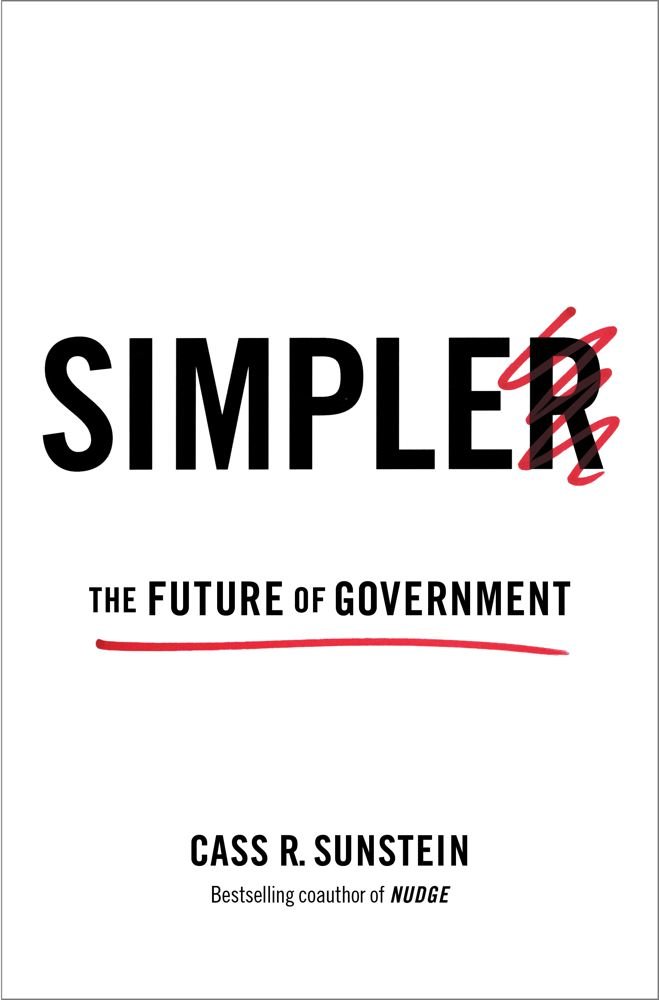
Cass Sunstein now has a new book (to be published April 9th), Simpler: The Future of Government. Sunstein has some experience in putting his ideas to practice, as this Fortune article describes:

Cass Sunstein, a friend of Obama’s from his University of Chicago Law School days, spent the last four years running the Office of Information and Regulatory Affairs (OIRA). It’s an obscure but exceedingly powerful perch that enabled Sunstein to put his imprint on everything from fuel efficiency standards and the redesign of the food pyramid to the rules for the landmark health care and Wall Street overhauls.

Sunstein used his office as a laboratory for his brand of “libertarian paternalism” — his self-described and seemingly paradoxical approach to structuring prompts for people that promote their welfare by protecting them from their more self-destructive impulses.

I suppose we are bound to hear more and more about libertarian paternalism. This is not new to those of you who just took Comparative Economic Systems, and neither are the warnings of Harvard’s Ed Glaeser on the dangers of “soft paternalism.” That leaves just one last question: What would Hayek say? Economics student Ryan Kottman answered that question for the Comparative Economics crowd in his presentation on “libertarian paternalism:” Hayek would worry very much about the government’s nudging leading to less individual responsibility. Kottman quotes Hayek’s Constitution of Liberty: “We assign responsibility to a man, not in order to say that as he was he might have acted differently, but in order to make him different.”

Rainy Days and Mondays and 8 a.m. Finals

Sunday, March 10th, 2013

The big events seem to be steady rain and the onset of finals, so my guess is that you are busy being busy, doing things like studying and writing papers. Or, possibly even taking a break and surfing the internet.  Why else would you be reading this? 

How much is that internet worth to you, anyway?  Probably a lot.  

The Economist surveys the evidence.

See you in the Spring.

Lawrence Today Links

Wednesday, November 28th, 2012

The new Lawrence Today showed up in my mailbox today, and as promised I have provided another few hundred words on the dynamics of the college wage premium.  You can click here to read my post on what exactly “composition-adjusted log real wages” means, along with a discussion about the trajectory of U.S. wages over the past 50 years.

For those of you interested in learning more about Michael Lewis’s Moneyball, my short review is here via the Economics Department Newsletter (if you are interested in getting on the distribution list for the newsletter, let one of us know). Here on Briggs 2nd and across campus we’ve talked quite a bit about Moneyball. For a taste, here are some discussions about how Moneyball might apply to higher ed, whether Major League Baseball is competitive, and why we should perhaps require kindergarten transcripts.

If you are looking for something that might pique your interest in economics, here are some suggestions:  First, one of our all-time most popular topics for classroom discussion is the problem of moral hazard.  I would also recommend the posts on the dynamics and continuing evolution of the publishing industry (who knew that an Oprah recommendation actually decreases overall book sales?).  Finally, if you are looking for something meatier, check out our (well, my) book recommendations.

Thanks for stopping by.

Presidential Candidates and the Economy

Tuesday, October 30th, 2012

Tonight (Tuesday, 10/30) Amnesty International is hosting a panel of Lawrence professors talking about the presidential candidates at 7 p.m. in the Cinema.  In addition to human rights issues, the panel will address the potential economic implications of the upcoming elections.  In preparation for the panel, I took a look for some general sentiment from the economics profession.  Here are a few choice items:

My first-order reaction was that it doesn’t matter much one way or the other who gets put into office in terms of the broad macro implications, but that is possibly because my macro expertise isn’t what it might be.  It’s pretty clear that November’s winner will have a pretty pronounced influence on certain aspects of administrative regulation, with possibly significant implications for the energy and health care sectors.

UPDATE:  Here are some links to works discussed this evening:

Andrew Gelman, Red State, Blue State, Rich State, Poor State, Why Americans Vote the Way They Do. (Article in Quarterly Journal of Political Science and link to the Book).

Thomas Frank, What’s the Matter with Kansas?

More Principals of Economics

Saturday, October 27th, 2012

David Warsh of Economic Principals has a nice piece on the Nobel Prize winners, Al Roth and Lloyd Shapley.   You may have heard something about Roth, and Warsh describes him as immediately relevant to modern market making:

[H]e is surrounded by generations of students and researchers, some of them computer scientists, working on all kinds of cutting-edge topics.  These include circuit breakers (forced trading halts) in panicked markets, random assignments in long waiting lines, school choice, new wrinkles in the auction of broadcast spectrum rights, corporate restructuring refinements and all manner of other market processes, anything, in other words, that might be improved by a little engineering.

As for Shapley, I didn’t know much about him beyond my familiarity with the Shapley Value.  It turns out Shapley kept rather spectacular company, including the likes of John Von Neumann and John Nash.   Robert Aumann called him the “greatest mathematical game theorist.”  Wow.

You’ll definitely learn something from reading this piece.

More here.  Cool.

Coase Goes to China… Literally

Monday, April 9th, 2012

Back in 1937 Ronald Coase asked a question fundamental to the economics of organizations — why are there firms?  Then in 1960 he pointed out that externalities stem from the reciprocity of the relationship between harmer and harmee, and that the failure to negotiate and enforce contracts is fundamental to the persistence of “externalities.”  As he says in his essay in “The Nature of the Firm: Influence“:

Transaction costs were used in the one case to show that if they are not included in the analysis, the firm has no purpose, while in the other I showed, as I thought, that if transaction costs were not introduced into the analysis, for the range of problems considered, the law had no purpose (62). 

For these seminal contributions he picked up the Nobel Prize in Economics in 1991 and shortly thereafter helped found — along with Douglass North — the International Society for the New Institutional Economics.

Now, in 2011, he asks the questions, how and why did China go capitalist?  And here comes the book later this month.

China’s road to capitalism was forged by two movements. One was orchestrated by Beijing; its self-proclaimed goal being to turn China into a “modern, powerful socialist country.” The other, more important, one was the gross product of what we like to call “marginal revolutions.” It involved a concatenation of grass-roots movements and local initiatives.

Here’s some more.

There’s a lot of New Institutional Economics work on China, by some very heavy hitters.


Ben Bernanke: The Hero or the Villian?

Thursday, March 15th, 2012

Just in time for your Spring break, Roger Lowenstein (of When Genius Failed fame) gives us an exhaustive profile of Fed chair Ben Bernanke in this month’s Atlantic Monthly.

I am in the middle of big stacks of papers here, so I haven’t had time to plow through the 8,000+ word article, but I like the teaser:

The left hates him. The right hates him even more. But Ben Bernanke saved the economy—and has navigated masterfully through the most trying of times.

Lowenstein appears to cover a lot of ground, including the Krugman v. Rogoff debate.  Here’s a summary and discussion at The Money Illusion blog.


Keynes, Cowen & Capitalism — Related Items

Thursday, March 8th, 2012

I checked my RSS feeds today and saw two interesting items, spot on in terms of our class discussion.  First up, an important technological breakthrough in medicine?  Here’s Walter Russell Mead:

The medical world may be on the verge of a major breakthrough on par with the discovery of penicillin. As profiled in this NYT piece, a number of Silicon Valley companies and entrepreneurs are looking to lower the price of genome sequencing to the point that it will be within reach of the average consumer (below $1,000)—a development which could lead to the biggest revolution in drugs and medical treatments in years.

On par with penicillin? That’s a lot of value.

Now for something completely different, Derek Lowe suggests that maybe, just maybe, we don’t need more scientists after all. Hmm. I’m not sure I agree with that whole bit. Nonetheless, it’s thought provoking.

As a bonus, he cites a fantastically titled piece by Virginia Postrel, “How Art History Majors Power the U.S. Economy.” Postrel seems to agree with his point:

The argument that public policy should herd students into [Science, Technology, Engineering & Mathematics] is as wrong-headed as the notion that industrial policy should drive investment into manufacturing or “green” industries. It’s just the old technocratic central planning impulse in a new guise. It misses the complexity and diversity of occupations in a modern economy, forgets the dispersed knowledge of aptitudes, preferences and job requirements that makes labor markets work, and ignores the profound uncertainty about what skills will be valuable not just next year but decades in the future.

If you are interested in the average salaries and unemployment rates for different college major choices, Postrel cites this report out of Georgetown University that has some very illuminating figures.

Man Bites Dog Reading Book

Thursday, March 1st, 2012

It is well known that author’s clamor for Oprah’s endorsement because the book sales go bonkers, and sales of the author’s other books also go bonkers.  The conventional wisdom is that publishers love Oprah because she pumps up book sales.

On the other side of Chicago, however, Northwestern’s Craig Garthwaite has another tale to tell:  Oprah’s endorsements reduce overall book sales:

In the publishing sector, endorsements from the Oprah Winfrey Book Club are found to be a business stealing form of advertising that raises title level sales without increasing the market size. The endorsements decrease aggregate adult fiction sales; likely as a result of the endorsed books being more difficult than those that otherwise would have been purchased.

It is I who emphasized that startling finding. Here’s how Garthwaite describes it:

At the genre level, the post-endorsement period is marked by large sales declines in the romance, mystery, and action categories. These genres were popular prior to the endorsements in the geographic areas demonstrating the largest endorsement responses. Using quantitative measures of text readability, I show that endorsed titles require one additional year of education to read than is typical for romance, mystery and action books. Furthermore, the post-endorsement sales decline was largest following the endorsement of classic novels, which require nearly four more years of education to comprehend than typical romance, mystery, or action titles. Since the cost of consuming a book is the combination of the retail price and the opportunity cost of the time spent reading the text, the post-endorsement sales decline in publishing should be considered similar to endorsements in other sectors that shift consumers towards more expensive products.

The Late, Great Bubba Smith

I read through the paper this evening, and this will likely wind up on my Industrial Organization reading list for next year. We’ve seen a similar phenomenon in our analysis of the beer industry — advertising doesn’t increase overall sales so much as it redistributes sales within the sector. Indeed, we kick off that class with a simple advertising game model, where advertising expenditures are treated as a prisoner’s dilemma, and we learn why incumbents are often copacetic with an advertising ban.  The analogy here, I guess, is that a beer producer that heavily advertises a new, difficult-to-drink product could cause an overall beer consumption to go down (possible ad line: New Bud Super Dark: It’s Like Drinking a Bagel ! ).

I wonder if the “light beerrevolution of the 1970s had the opposite effect?

Via the fellas at Marginal Revolution.

Keynes, Cowen, Brynjolfsson, McAfee & Capitalism

Friday, February 17th, 2012

Here’s the update from the reading group.

On the subject of big, fat profits in the financial sector, you might consider visiting some of these pieces. On the subject of big, fat incomes in the financial world, Cowen offers up a simple theory on why so many smart young people go into finance, law, and consulting. Adding fuel to this fire, “Mr. D” sends me this helpful blog post from Ezra Klein, arguing that Ivy Leaguers head to the Street because that’s where they get their “real” education. Do you buy that? And, in a similar vein, “Mr. P” wants to know why Americans don’t elect scientists.

We left off yesterday with the open question of what the best-case scenario is for market economies moving forward.  Where are the big productivity gains going to come from? What type of work is to be done? Is manufacturing dead or alive, or does it even matter? (See Professor Finkler’s previous post).  Has John Stuart Mill’s concern about the inevitable decline in radical breakthrough inventions finally come home to roost?

And, this opens the door for next week’s book, Brynjolfsson and McAfee’s Race Against The Machine: How the Digital Revolution is Accelerating Innovation, Driving Productivity, and Irreversibly Transforming Employment and the Economy.  There are a couple of secondary sources on this, as well, including pieces from The Economist and The Wall Street Journal.

By all rights, this term’s 391 DS reading group should be titled Keynes, Cowen, Brynjolfsson, Backhouse, Bateman, McAfee, and Capitalism, but that doesn’t quite roll of the tongue, does it?

Nor would it fit on your transcript.

Could tiny organisms carried by house cats be creeping into our brains?

Friday, February 10th, 2012

Crazy, awesome, completely plausible:

Jaroslav Flegr is no kook. And yet, for years, he suspected his mind had been taken over by parasites that had invaded his brain. So the prolific biologist took his science-fiction hunch into the lab. What he’s now discovering will startle you. Could tiny organisms carried by house cats be creeping into our brains, causing everything from car wrecks to schizophrenia? A biologist’s science- fiction hunch is gaining credence and shaping the emerging science of mind- controlling parasites.

In other words, Reading Period continues

Early Holiday Book Recs

Wednesday, November 16th, 2011

Ah, Winter Break is almost upon us, which means that it is almost time to get to my pile of books.  I’m not sure what came over me, but I just went out and bought a whole bunch more that I can’t possibly get to.

Here’s the latest in the queue:

Roger E. Backhouse and Bradley W. Bateman Capitalist Revolutionary: John Maynard Keynes.  I picked this one up after reading this New York Times piece where the authors argue that contemporary economists are lacking in the “worldly philosophers” department (see also the previous post).

Douglas W. Allen The Institutional Revolution: Measurement and the Economic Emergence of the Modern World.  A perfect little something for the New Institutionalist that has everything. Allen is an expert on transaction cost economics, co-author of some great work on agriculture contracts, and one of the funnier economists you are likely to ever meet. I will bet dollars to donuts that the book contains at least one example that you’ll be dropping at your next mixer (From the publisher: “Allen provides readers with a fascinating explanation of the critical roles played by seemingly bizarre institutions, from dueling to the purchase of one’s rank in the British Army”).  It says available December 1, but I got my copy in the mail today.

Eugene Fitzgerald, Andreas Wankerl, and Carl Schramm. Inside Real Innovation: How the Right Approach Can Move Ideas from R&D to Market – And Get the Economy Moving.  Schramm is from Kauffman, one of our recent visitors to the innovation class touted this as a must read, and I hear rumors that this will rear its head in Econ 405 next term.  A convincing trifecta!

Michael Lewis Boomerang: Travels in the New Third World.  If you read this blog semi-regularly, you’ve probably seen something about Lewis’ new compilation of economic disaster tourism writing.  I was going to recommend this as an e-book, but it has an unusually awesome dust jacket. Great for the plane.

Gretchen Morgenson and Joshua Rosner Reckless Endangerment: How Outsized Ambition, Greed, and Corruption Led to Economic Armageddon.  This was on my wish list and I no longer remember who tipped me off to it.  Looks great, if a bit thick.

I have some course-related pieces that probably aren’t such fab holiday gift ideas, but I will get to them as I get to them.

Enjoy!